What Is Carbon Sequestration and How Does It Work Underground?
At Lonquist, our team works at the intersection of traditional energy development and emerging carbon capture and storage (CCS) applications; it's the kind of applied subsurface work we do. Consider this article to be a plain-English guide for anyone trying to understand what sequestration means when evaluating CCS feasibility.
Carbon Sequestration: Capturing and Storing CO₂
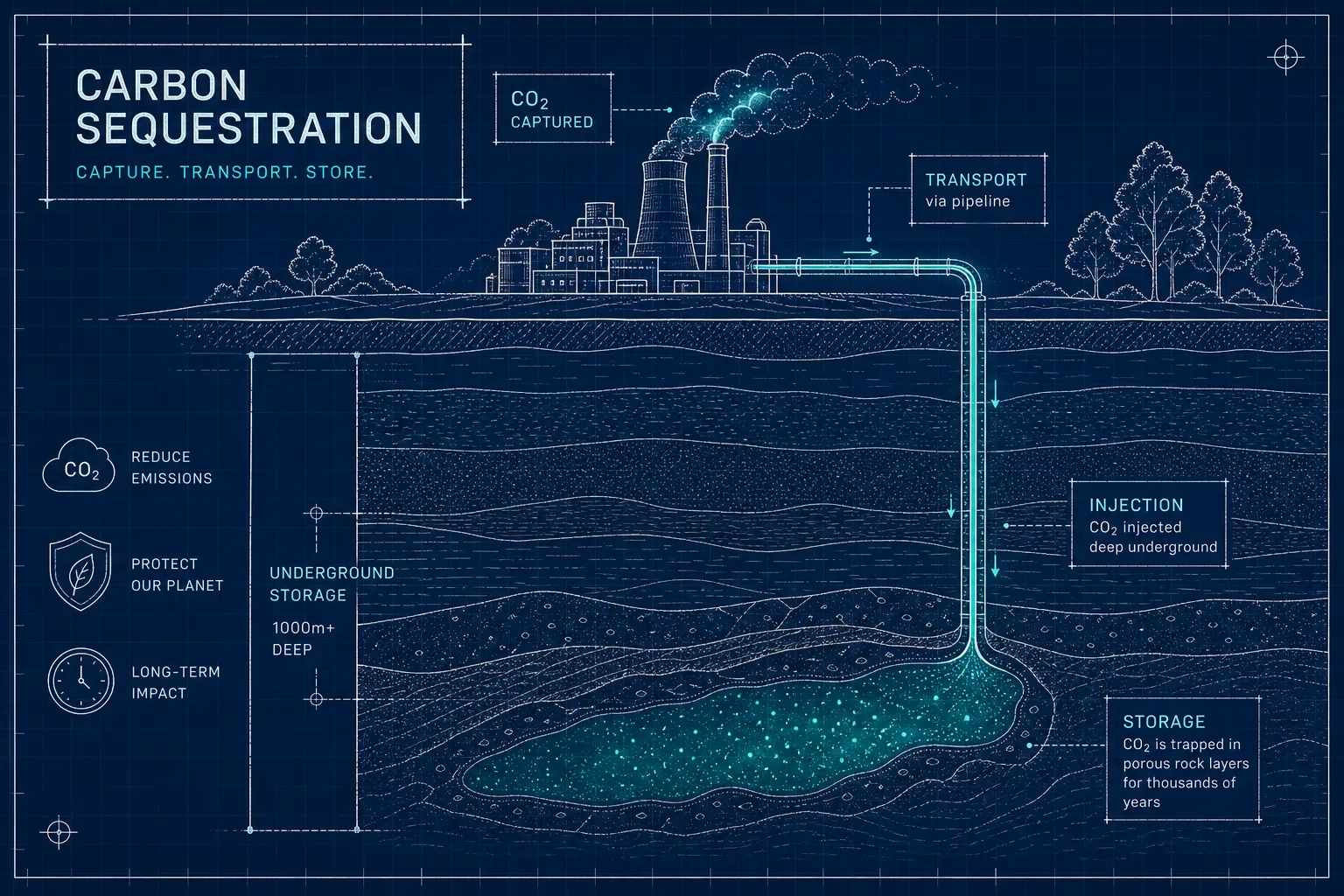
Carbon sequestration is the process of capturing CO₂ and storing it in a way that prevents it from re-entering the atmosphere. Natural methods include forests and soils, which absorb CO₂ through photosynthesis and store it in biomass and organic matter. Technological methods, particularly geologic sequestration, involve capturing CO₂ from industrial sources and injecting it deep into underground rock formations.
For an overview focused specifically on subsurface approaches, see our companion article: What Is Geologic Carbon Sequestration? CO₂ sequestration through geologic storage is generally considered more permanent than biological storage because the carbon is isolated from the surface carbon cycle entirely, which is why it requires the most complex engineering and the most rigorous site analysis. Geologic storage also plays a central role in scaling carbon management strategies.
Three main geologic targets are used for large-scale CO₂ sequestration in the United States: deep saline aquifers, depleted oil and gas reservoirs, and unmineable coal seams. Deep saline aquifers hold the largest storage potential overall, particularly along the Gulf Coast from Texas to Georgia, and they're attractive because they contain non-potable water and don't compete with drinking water supplies. Depleted reservoirs offer the advantage of existing well infrastructure and known geologic data.
Two rock properties determine whether a formation can actually do the job:
Porosity is the available storage space within the rock, or how much room there is for CO₂ to occupy.
Permeability is how easily fluids move through the rock, which determines how efficiently CO₂ can be injected without excessive pressure buildup.
Both matter. High porosity with low permeability means the storage capacity exists, but injection will be difficult; high permeability with low porosity means CO₂ moves freely, but there isn't much space to hold it.