
How CO₂ Injection Works
Compression, Wellbore Delivery, and Pressure Management
The injection process starts at the CO₂ source: a power plant, cement facility, or industrial operation where CO₂ is captured from the flue gas stream. From there, the CO₂ is compressed to its supercritical state, transported via pipeline to the injection site, and pumped down a Class VI injection well into the target formation. The wellbore itself must maintain pressure integrity across the entire depth, with casing and cement designed to resist corrosion from CO₂-brine mixtures, which are substantially more aggressive than standard wellbore fluids. Pressure management during injection is not a passive process. Operators define an operational window that keeps bottom-hole pressure above the minimum necessary to inject but below the fracture pressure of the formation and caprock. Many engineering workflows use approximately 90% of formation fracture pressure as a conservative safety buffer, a threshold consistent with guidance for managing subsurface pressure during injection operations. Exceeding that limit risks hydraulic fracturing of the caprock, which is the one outcome every CCS project is designed to prevent.
The Four Mechanisms That Trap CO₂ Underground
Once injected, CO₂ is held in place through four distinct trapping mechanisms that operate across different timescales. Structural trapping is immediate: CO₂ is held beneath the impermeable caprock by physical containment, the same way natural gas accumulates in a reservoir prior to extraction.
Residual trapping develops over years to decades as CO₂ migrates through the formation and becomes immobilized as disconnected droplets in pore spaces, where it is unable to flow further. Solubility trapping occurs over years to centuries as CO₂ dissolves in formation brine. Once dissolved, it becomes denser than the surrounding fluid and sinks rather than rises, adding a gravitational assist to containment.
Mineral trapping is the most permanent form, where dissolved CO₂ reacts with rock minerals over centuries to millennia to form stable carbonate compounds. The engineered reliability of a CCS project depends mostly on structural and residual trapping in the near term; mineral trapping is a long-term benefit that develops well after injection has ended.
Monitoring Injected CO₂: What Operators Track and Why It Matters
Technologies Used to Track CO₂ Plumes Underground
Monitoring a CO₂ plume is a regulatory requirement under the Class VI permit and a fundamental risk management obligation, not an optional best practice. The primary tool is 4D seismic surveying, where repeated seismic acquisitions over time reveal changes in the subsurface that indicate where the CO₂ plume has migrated. This time-lapse approach is widely used across DOE-funded demonstration projects and is consistent with EPA monitoring guidance for Class VI wells. In real time, pressure and temperature gauges in injection and observation wells keep track of how the formation is reacting.
Wellbore integrity logging confirms that casing and cement remain sound throughout the injection period and after. Geochemical sampling of groundwater above the storage formation can detect any CO₂ migration that seismic surveys might miss in early stages. Monitoring programs don't end when injection stops. EPA requires continued post-injection monitoring until the operator can demonstrate the site no longer poses a risk to underground sources of drinking water, a process that can extend for years or decades after the final injection volume is placed. The monitoring program design, including which technologies are deployed and at what frequency, is part of the Class VI permit and must be agreed upon before operations begin.
Leakage Risk, Induced Seismicity, and Operational Safeguards
Two operational risks dominate regulatory and technical attention in CCS projects. To manage CO₂ leakage risk, the project team carefully selects formations and caprock, continuously monitors pressure, and compares measured data against modeled forecasts in real time. If pressure trends toward the fracture limit, operators reduce injection rates or shut in temporarily. Induced seismicity risk, which arises from pressure buildup in the formation, is managed through microseismic monitoring networks and by staying within defined pressure limits throughout the injection program.
Both risks are manageable with proper engineering and site selection. Managing them well requires expertise that spans reservoir characterization, geomechanics, wellbore design, and construction, not just one of those disciplines in isolation. Projects that treat CCS as purely a science problem, without the construction and operational rigor to back it up, tend to encounter the more difficult problems late, when they’re most expensive to correct.
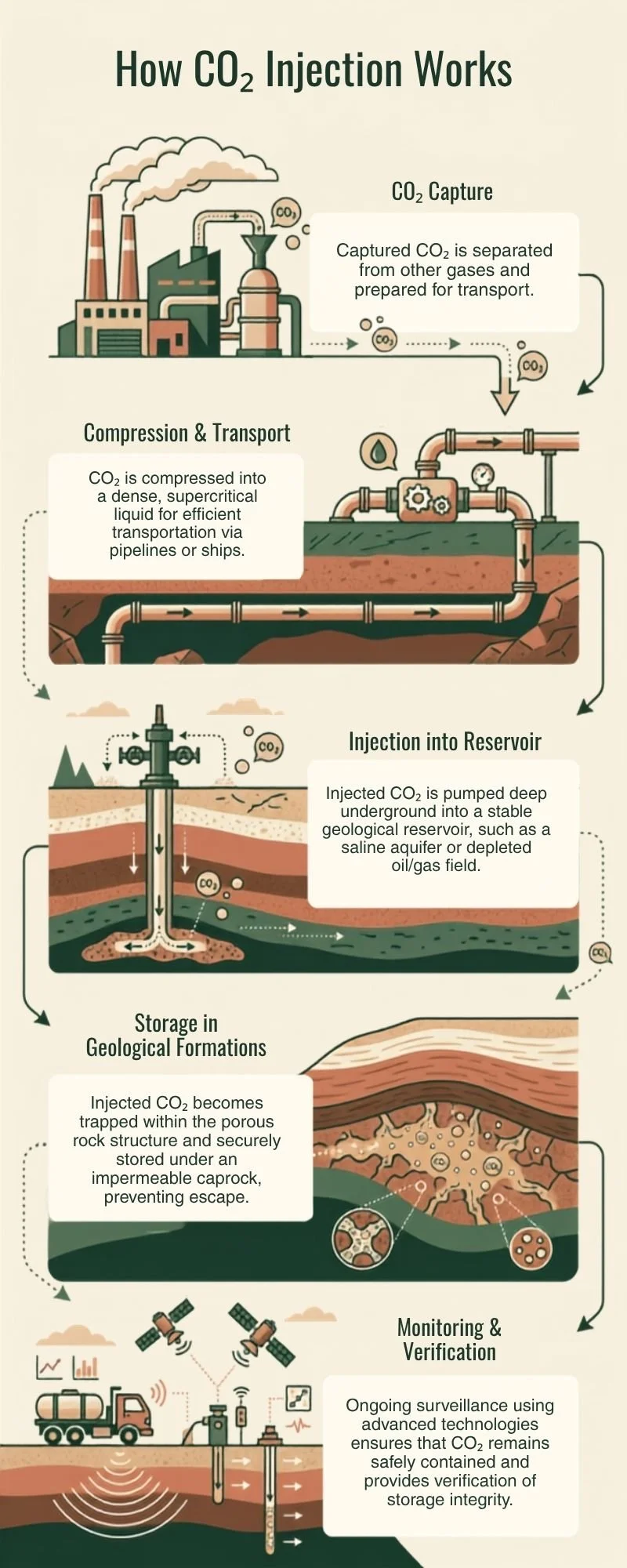
Human and ai-generated infographic
From Subsurface Science to CCS Project Execution: Bridging the Gap
What a CCS Project Actually Requires from an Engineering Team
CCS projects sit at the intersection of reservoir engineering, wellbore design, surface construction, regulatory compliance, and long-term operational planning. Most operators pursuing CCS, especially those entering from outside traditional oil and gas, don't have deep in-house capability across all of these simultaneously. The result is that execution risk concentrates at the handoff points: between the reservoir model and the drilling program, between the injection design and the surface construction plan, and between the field data and the monitoring report submitted to regulators. Those handoff points are where projects lose time and money.
A geologic model that doesn't translate cleanly into a constructable well design creates rework that compounds quickly: delayed permits, cost overruns, and frustrated investors who built their schedules around a project that has stalled at a discipline boundary. A monitoring plan that wasn't coordinated with the drilling program creates the same problem at a different phase. These aren't edge cases; they're the most common source of mid-project surprises in CCS execution.
Where Lonquist Fits in the CCS Landscape
Lonquist combines deep subsurface engineering expertise with hands-on construction execution. In the CCS space, that combination matters because the work doesn't split cleanly between "the science" and "the build." Operators who have to manage that coordination across separate firms absorb the friction themselves in schedule risk, in cost, and in the gaps that open up when two teams are working from different assumptions about the same subsurface.
Lonquist's background in reservoir characterization, well design, and field project management means CCS clients get a team that can turn a geologic model into a buildable injection program and carry it from permit application through regulatory compliance. That continuity reduces the coordination risk that tends to surface at handoff points between disciplines, and in a project type where permitting timelines are long and rework is expensive, avoiding those delays is a meaningful advantage.